
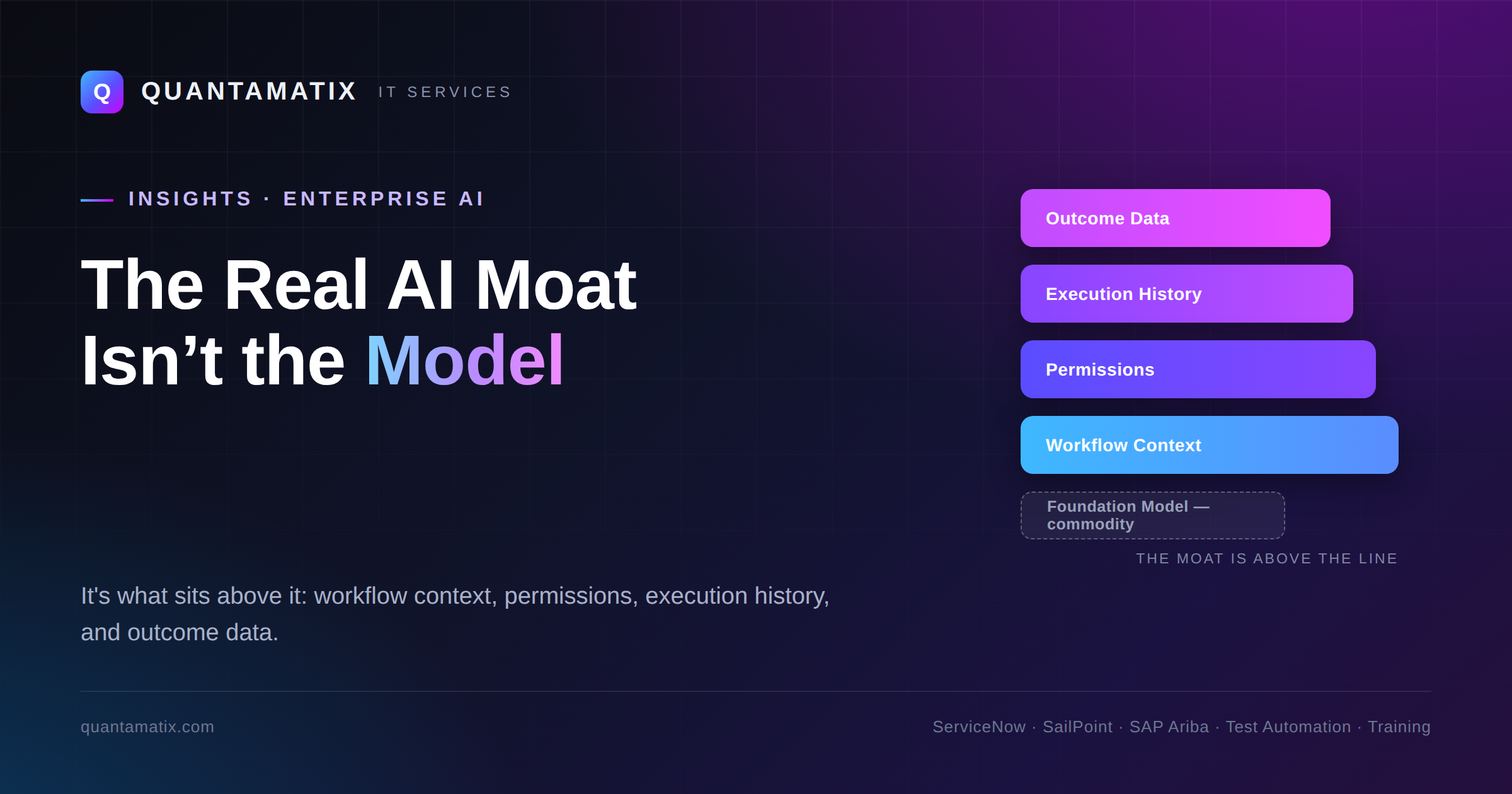
Workflow context, permissions, execution history, and outcome data are a stronger competitive advantage than access to any particular LLM. Here’s why enterprises chasing the “best model” are solving the wrong problem.
Walk into almost any enterprise AI strategy meeting this year and you’ll hear some version of the same question: which model should we standardize on? GPT, Claude, Gemini, Llama — pick a side, brief the board, move on. It feels like the decision that matters most. It probably isn’t.
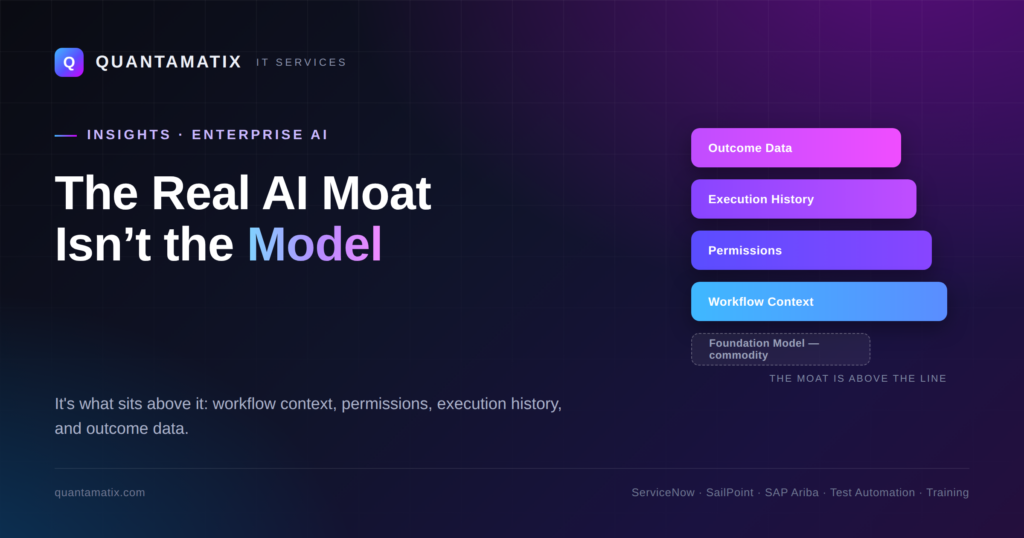
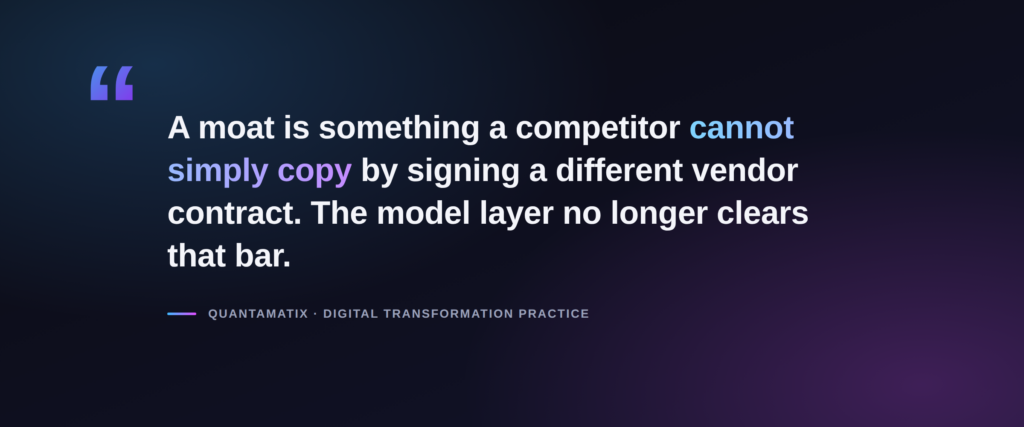
Foundation models are converging fast, and switching between them is close to trivial at the API level. A prompt written for one frontier model runs, with minor tuning, on another. Model choice is a real decision, but it is not a moat — because a moat, by definition, is something a competitor cannot simply copy by signing a different vendor contract. The model layer no longer clears that bar. What still does is everything an enterprise has already built above it: the workflow context that tells an agent how work actually moves through the organization, the permission structure that governs what it’s allowed to touch, the execution history that lets someone reconstruct what it did and why, and the outcome data that proves whether any of it helped.
The platform vendors themselves have quietly reached the same conclusion. In May 2026, SailPoint launched Agentic Fabric specifically to secure AI identities across the enterprise — treating AI agents as a distinct identity class that needs lifecycle management, access certification, and least-privilege enforcement, the same governance discipline that’s long applied to human users. Weeks later, at Knowledge 2026, ServiceNow launched Action Fabric with an explicit goal: to open its “full system of action” to every AI agent in the enterprise, positioning the platform as the control layer that lets agents actually execute work rather than just suggest it. Neither company is trying to build a better model. Both are racing to own the infrastructure that makes any model useful and safe inside a real organization. That’s the tell.
Four layers that actually matter
Strip away the vendor language and the same four requirements show up everywhere agentic AI gets deployed successfully.
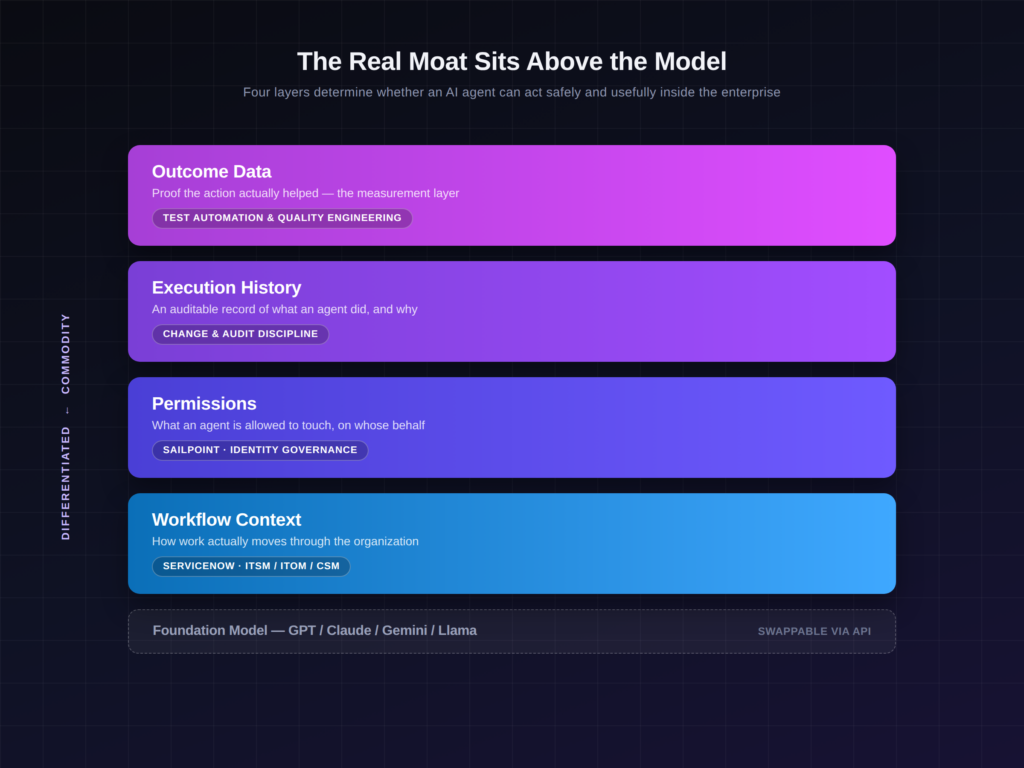
Workflow context. An agent that doesn’t understand how your organization actually routes incidents, approves changes, or fulfills a service request is going to guess — and guessing inside production systems is expensive. This is the layer ServiceNow has spent two decades building: a live map of services, dependencies, and process logic across ITSM, ITOM, CSM, and HRSD. An agent plugged into that structure can act with judgment. An agent plugged into a blank API has none.
Permissions. Before an agent acts, something has to answer a much older question with a new urgency: who — or what — is allowed to do this, on whose behalf, and under what conditions? Identity governance platforms like SailPoint were built to answer exactly that for human users — provisioning, certification, segregation-of-duties enforcement, least privilege. Extending that same discipline to agent identities isn’t a bolt-on; it’s the difference between an agent that operates inside defined guardrails and one that’s a standing liability waiting to be discovered during an audit.
Execution history. Autonomy without an audit trail is a governance failure waiting to happen. As agents move from suggesting actions to taking them, the ability to reconstruct exactly what an agent did, in what order, and why becomes as important as the action itself — both for compliance and for the far more mundane task of debugging when something goes wrong. This is the same discipline enterprises already apply to change management and incident history; it simply has to extend to a new class of actor.
Outcome data. None of the above matters if you can’t measure whether it worked. This is where quality engineering earns its place in the conversation: the same rigor that validates whether a code release actually improved performance or introduced regressions is exactly what’s needed to validate whether an AI agent’s output is trustworthy, accurate, and worth the cost of running it. Without a measurement layer, “AI adoption” is a belief, not a result.
The diagnostic most companies skip
Here’s the uncomfortable part: most organizations don’t actually know how strong their position is across these four layers. They know, in general terms, that AI could save time and reduce cost. Very few can say precisely where their workflows are undocumented, where their permission models haven’t been touched since the last audit, where execution history is scattered across systems that don’t talk to each other, or where “we think it’s working” is standing in for an actual number.
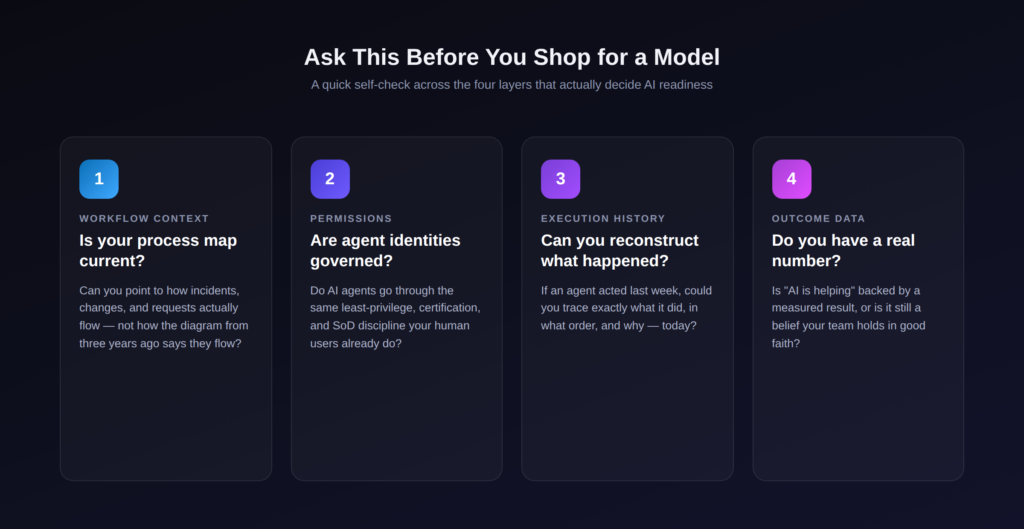
That’s not a model problem. It’s a visibility problem — and it’s the exact gap Quantamatix’s AI Time Audit was built to close, one team at a time: a short discovery conversation, a rigorous mapping of where time and structure are actually breaking down, and a concrete plan built around tools that fit the workflows, permissions, and systems already in place, not a generic best-practice list. The same logic that applies to reclaiming five hours a week for an individual scales directly to the four-layer question at the organizational level. You cannot build a durable AI advantage on top of a workflow layer, permission model, and measurement system you haven’t actually looked at.
Where this leaves the model question
None of this means model selection doesn’t matter — it means it isn’t where the differentiation lives, and it isn’t where enterprises should be spending most of their strategic attention. The organizations that will have a genuine advantage in an agentic AI world are the ones whose workflow platforms are well-architected, whose identity governance already treats non-human identities as first-class citizens, whose systems keep an honest record of what happened, and whose quality practices can tell the difference between an agent that helps and one that only looks like it does.
That’s a platform and governance problem before it’s a model problem — and it’s exactly the layer Quantamatix works in every day, across ServiceNow, SailPoint, SAP Ariba, and test automation. If your organization is further along on the model question than it is on the four layers underneath it, that’s worth fixing first.