For a decade, enterprise automation meant one thing: software that follows rules. You mapped a process, defined the conditions, and the system executed the same steps every time. It was faster than people, but it was never smarter than the process you gave it.
That era is ending. The new generation of enterprise AI doesn’t just follow workflows — it works. AI agents can now read an incoming request, decide what it means, gather the context they need, take action across multiple systems, and close the loop without a human touching the process. Analysts and vendors have converged on a name for this shift: the autonomous workforce — a layer of digital workers operating alongside your human teams.
The hype is loud, and much of it deserves skepticism. But underneath the marketing, something real is happening, and it will change how IT and business operations are organized. Here’s a clear-eyed look at what the autonomous workforce actually is, what it changes, and what your organization should be doing about it now.
From assistants to workers: what actually changed
It helps to see this as three distinct generations of workplace AI:
- Assistive AI drafts, summarizes, and suggests. A human reviews everything and takes every action. Copilots and chatbots live here. Useful, but the human still owns the process.
- Agentic AI executes defined tasks with some autonomy — reset a password, triage a ticket, update a record — but each agent handles a narrow step, and humans stitch the steps together.
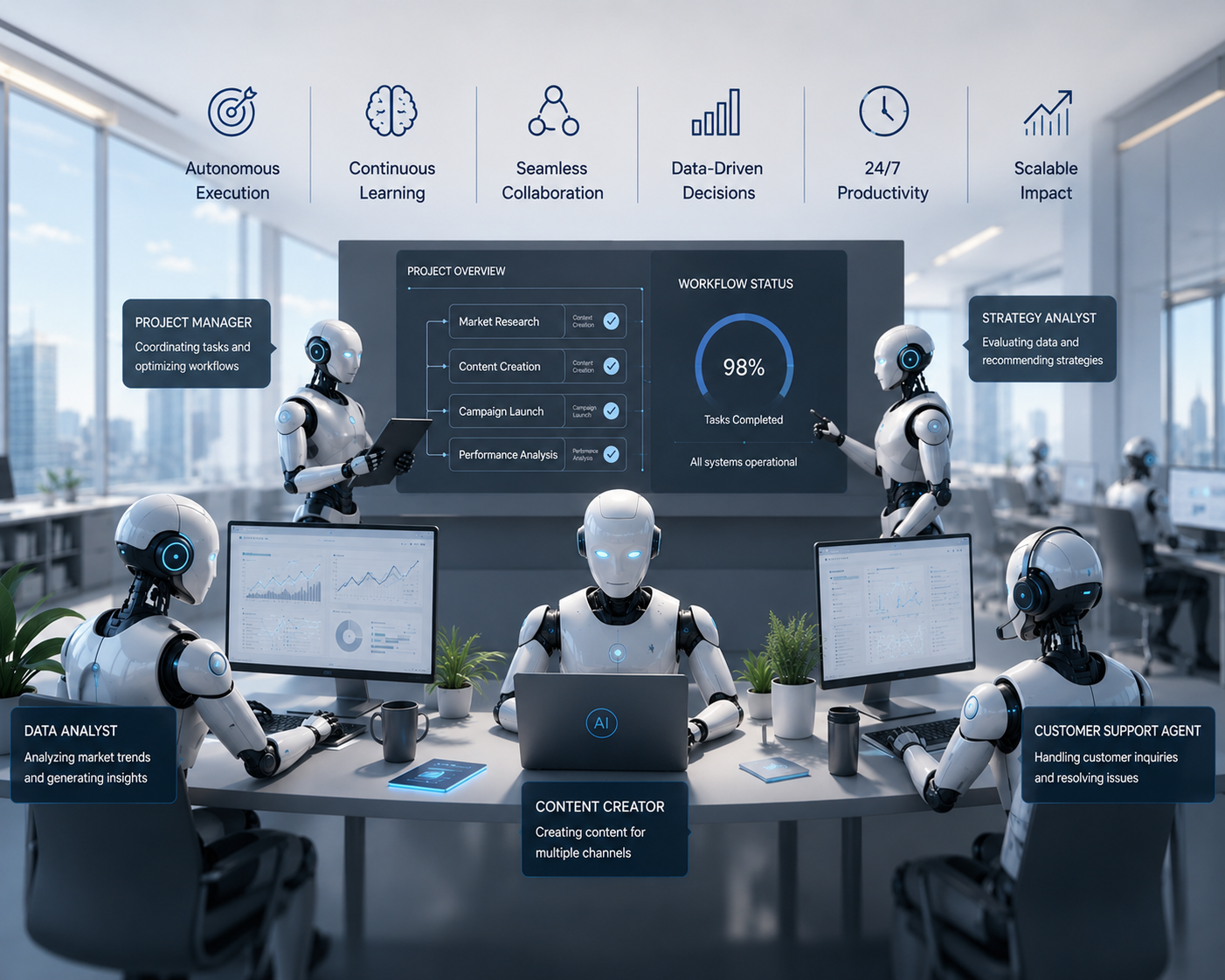
- The autonomous workforce is the third stage: role-scoped digital workers that own a process end to end. Think of a digital service desk analyst that receives an issue, diagnoses it, resolves it, documents it, and escalates only the cases that need human judgment.
The difference between stage two and stage three is not intelligence — it’s accountability. An autonomous digital worker has a defined role, a scope of authority, permissions, and outcomes it is responsible for. In other words, it starts to look less like a feature and more like a member of staff. That framing is exactly why the management challenge is bigger than the technology challenge.
Why this is happening now
Three forces are converging. First, labor economics: aging workforces and persistent skills shortages mean many organizations simply cannot hire their way out of growing operational workloads. Second, the technology crossed a threshold — large language models can now reliably interpret unstructured requests, and orchestration frameworks let them act across systems rather than just talk about them. Third, the economics of service operations demand it: a large share of enterprise service volume — password resets, access requests, status inquiries, routine approvals — is repetitive, well-documented work that is expensive for humans to do and unsatisfying for the humans doing it.
That last point matters. The strongest early results for autonomous digital workers are in exactly these high-volume, low-ambiguity domains. The pattern across early adopters is consistent: routine request volume shifts to digital workers first, and human teams move up the stack toward complex, judgment-heavy work.
What the autonomous workforce changes in your organization
1. Process documentation becomes a hard dependency. A digital worker can only own a process you can describe. Undocumented tribal knowledge — the workaround only one senior engineer knows — is invisible to it. Organizations with mature, well-documented processes will automate quickly; organizations that run on heroics will stall. The uncomfortable truth: autonomy exposes process debt.
2. Data quality moves from hygiene to prerequisite. Autonomous action is only as good as the context behind it. If your asset inventory is stale, your knowledge base contradictory, or your customer records fragmented across systems, a digital worker will act confidently on bad information. Before autonomy, bad data caused slow decisions; after autonomy, it causes fast, wrong actions.
3. Governance becomes an operating discipline, not a policy document. Digital workers are non-human identities with credentials, permissions, and the ability to act. That raises questions most organizations have never had to answer: Who approves a digital worker’s scope of authority? Who reviews its access — and how often? What does an audit trail of autonomous decisions look like? What triggers suspension? Someone needs to own these answers the way someone owns change management today.
4. The human role shifts from doing to directing. As routine execution moves to digital workers, the roles that grow in value are process designers, knowledge managers, exception handlers, and AI supervisors — people who define what good looks like and intervene when reality departs from the script. This is a retraining opportunity as much as an efficiency play, and the organizations that treat it that way will keep their best operational talent.
5. Trust must be earned in stages. No responsible organization goes from zero to full autonomy. The proven path is graduated: start with human-in-the-loop (the digital worker proposes, a human approves), move to human-on-the-loop (it acts, humans monitor and can intervene), and grant full autonomy only for case types where accuracy is demonstrated over time. Autonomy is a privilege a digital worker earns per process — not a switch you flip.
The risks nobody should gloss over
A candid assessment requires naming the failure modes. Autonomous systems can act outside their intended scope when instructions are ambiguous. They can be manipulated — a digital worker that reads incoming messages and takes actions is a new attack surface. They can silently degrade as the environment changes around them. And they can create accountability gaps: when an autonomous action causes harm, “the AI did it” is not an answer regulators, customers, or courts will accept.
None of these risks is a reason to wait. All of them are reasons to build governance, observability, and human oversight into your autonomy program from day one — not to retrofit them after the first incident.
A practical readiness sequence
You don’t need to deploy digital workers this quarter. You do need to become the kind of organization that can deploy them safely. A pragmatic sequence:
- Map your candidates. Identify your highest-volume, most repetitive processes. Which have documented, deterministic resolution paths? That’s your shortlist.
- Fix the data those processes depend on. Audit the accuracy of the records, knowledge articles, and inventories a digital worker would rely on. Close the gaps before piloting.
- Assign governance ownership. Name the person or board that approves digital worker scopes, reviews access, and owns the audit trail — before the first pilot.
- Pilot one process, human-in-the-loop. Pick a contained, measurable process. Measure accuracy and rework, not just speed. Expand scope only on evidence.
- Invest in your people in parallel. Train operational staff toward supervision, exception handling, and process design roles. Announce this early — the fear of replacement kills adoption faster than any technical failure.
The bottom line
The autonomous workforce is not science fiction, and it is not next decade’s problem. The technology is deployable today for a meaningful slice of enterprise work, and the gap is widening between organizations that are building the prerequisites — documented processes, trustworthy data, real governance, prepared people — and those that are waiting to see how it plays out.
Waiting feels safe, but it isn’t neutral. The prerequisites take quarters to build. Organizations that start now will adopt autonomy on their own terms, at their own pace, with their own guardrails. Those that don’t will eventually adopt it under pressure — from competitors, from costs, or from vendors — on someone else’s terms.